
Strengthening Access to Quality Primary Education in Dhemaji (SAQED)
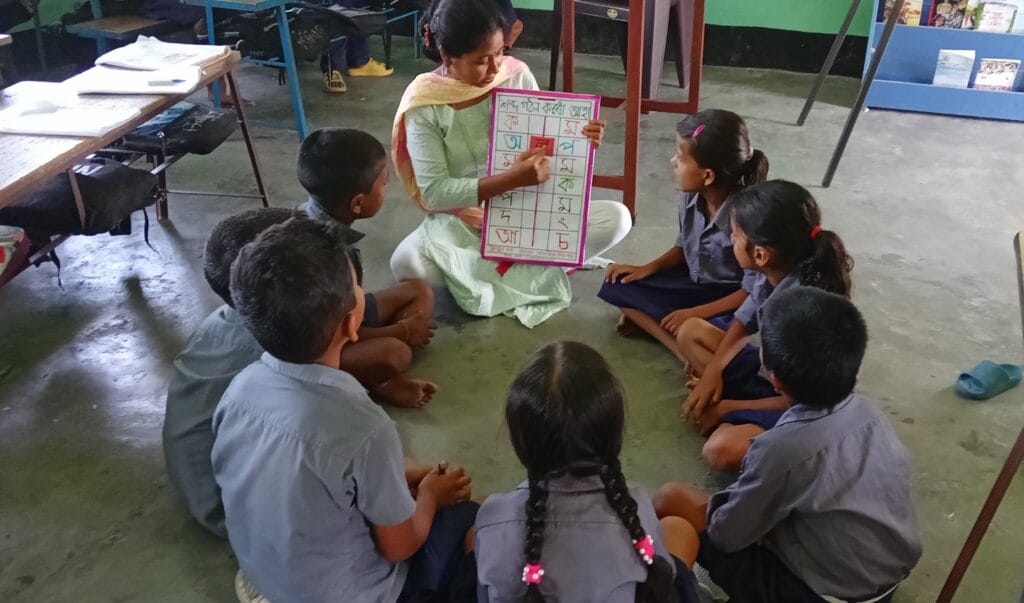
Murkongselek block, situated in the Jonai co-district of Dhemaji district in Assam, is one of the blocks identified under the Aspirational District Program of NITI Aayog. Located in the easternmost part of Assam and bordering Arunachal Pradesh, it forms part of one of the most flood-prone regions of the Brahmaputra valley. Despite vulnerabilities, Murkongselek has socio-economic importance, with a predominantly rural population and diverse ethnic communities, including Mising and Bodo tribes, along with other marginalised groups.
The absence of multilingual learning materials—especially in the Mising language—creates barriers to comprehension for children from tribal and linguistic minority communities. There is a need for structured, pedagogical support to teachers for effectively managing multilingual, multi-grade classrooms and to adopting activity-based, child-centred teaching approaches aligned with foundational literacy and numeracy (FLN) goals.
The ‘Strengthening Access to Quality Primary Education in Dhemaji’ (SAQED), an initiative supported by Tata Trusts, aims to strengthen the quality of primary education through such approaches in the Murkongselek block of Dhemaji district, Assam by ensuring that children in the early grades are build enhanced foundational literacy and numeracy skills through multilingual initiatives.
The SAQED initiative envisions that:
- At least 50% of the 12,300 lower primary school children in 250 schools will achieve age-appropriate learning outcomes around literacy and numeracy (as per the National Curriculum Framework)
- At least 60% of 500 primary-school teachers demonstrate improved classroom practices during follow-up mentoring visits and cluster-level observations
- At least 60% of 500 primary-school teachers in project schools are able to regularly access and utilise the multilingual resources from the Multilingual Knowledge Hub of Dhemaji DIET in their classrooms
- At least 60% of 250 schools with quarterly SMC and Mothers’ Groups meetings
- At least 60% SMCs and Mothers’ Groups contributes and develop school development plan (SDP)